

To his mother, he was Zachary, a loving and playful 21-year-old with the mental capacity of a 5-year-old due to a genetic mutation.
Zachary Moore lived and died at the Southeast Arkansas Human Development Center (SEAHDC) in Warren, Arkansas. It was there, on September 7, 2025, that Zachary tried to bite a nursing assistant. Several staff grabbed him and held him face down for 13 minutes while injecting him with the antipsychotic Geodon. He died shortly after, his death ruled a homicide.
The video showed that Zachary was neither protesting nor struggling at the time of the injection.
A system where 91 percent of abuse can simply be covered up is a system designed to protect not the helpless but those who harm them.
When the registered nurse was asked why an antipsychotic drug was used on a resident who was plainly not a threat to self or others, she replied, “I am just doing what I am told to do, and if we get an order, then we are required to give the medication.”
Twelve SEAHDC employees were dismissed following the incident. On March 17, six were charged with manslaughter and neglect of a vulnerable person.
Zachary’s mother, Angela Stephens, is now seeking a $725,000 settlement from the state.
But deaths like his are not isolated.
In 2020, David Cains, 42, died after being physically restrained by staff at the Booneville Human Development Center. After three years of legal proceedings, the Arkansas State Claims Commission found the Department of Human Services negligent and awarded his family $400,000.
The pattern is clear: An Arkansas HDC is anything but the warm, safe or caring environment you would expect for a loved one with intellectual disabilities. Disability Rights Arkansas (DRA), a nonprofit specializing in services and oversight for the state’s disabled population, reports finding piles of rotting trash in abandoned HDC rooms, a stagnant pool infested with mosquitoes and mold spreading throughout the facilities. One DRA report tells of:
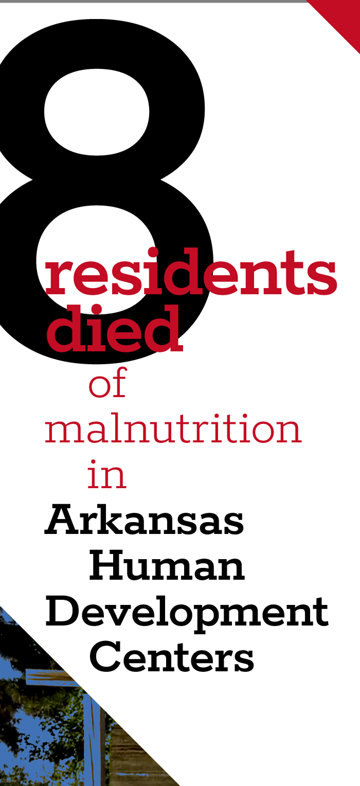
A resident so malnourished he had to be hospitalized. Finding no medical cause, DRA monitored his mealtimes after returning him to an HDC facility. They found that staff rushed his meals, saying, “I think you are done,” and failing to provide required supplements. A dozen residents were similarly mistreated and malnourished. Eight of them died.
Second-degree burns on the thighs and buttocks of a resident following a shower. Staff insisted that the water was “not too hot” and that the resident was merely “scrubbed” from head to toe.
An X-ray of an open fracture—bone through skin—requiring surgery. The resident said a staff member had stepped on their arm. The staffer claimed it was a fall. Nurses took an hour to respond and waited nearly two more hours before finally calling an ambulance.
The DRA has no enforcement power—it can only report and advocate. In the malnourishment case, its findings went unaddressed for five months. The other two, lacking video, became “he said, she said” cases, with internal investigations siding with staff over the victims.
With video surveillance reviewed in just 9 percent of 242 reported cases of negligence or abuse over a period of six months in Arkansas HDCs, the vast majority of reports remain impossible to corroborate, turning most “internal investigations” into a charade.
Where is the accountability?
Zachary’s hour of torture was videoed, and it contradicted the story told by the staff who held him down.
Arkansas Department of Human Services Secretary Janet Mann characterized the incident as “wholly unacceptable.”
Zachary’s mom had more to say: “I want to honor him by fighting for justice for him [and] for every child and resident still in the system.”
A system where 91 percent of abuse can simply be covered up is a system designed to protect not the helpless but those who harm them.
In Arkansas’ Human Development Centers, neglect doesn’t slip through the cracks—the cracks are the system.
“My son mattered. He’s not just a name and a file,” Stephens said.