

Then the public fought back—and won.
A loose but formidable coalition of news outlets, transparency advocates, First Amendment organizations and concerned citizens mobilized against Assembly Bill 1821, legislation that would have dramatically restricted Californians’ ability to find out what their government is doing.
On June 25, the bill was stripped of the provisions that open government advocates said would have gutted the California Public Records Act.
“Already California, by our studies, is 39th in the country for transparency.”
“The Senate Judiciary Committee heard overwhelming public pressure across the state of California and made a decision not to go forward with this terrible language,” Tracy Rosenberg, advocacy director of Oakland Privacy, told Freedom Magazine.
“They heard that message and they felt the pressure, so [the Assembly] went back to the original version of the bill.”
The bill, authored by Assemblymember Blanca Pacheco and supported by the League of California Cities and the California State Association of Counties, began as what Rosenberg described as a “fairly innocuous” proposal.
Its original purpose was to extend the required initial response period for a public records request from 10 calendar days to 10 business days.
Then the bill changed.
As new language was added, AB 1821 grew into a sweeping collection of restrictions, fees and procedural obstacles that could have made government records far more difficult—and far more expensive—to obtain.
Among other provisions, the bill would have allowed agencies to sue individuals whose requests they deemed “malicious.” It would have permitted agencies to charge commercial requesters between $22 and $66 per hour for searching for and reviewing records, with the fees subject to cost-of-living increases. It would also have given agencies greater control over how requests could be submitted.
One provision stated that a request would be considered properly submitted only if it was sent through a method designated by the agency.
That seemingly technical language carried enormous consequences.
An agency could potentially limit requests to a particular portal, format or method of delivery, creating new opportunities to reject, delay or obstruct requests on procedural grounds.
Dr. David Cuillier, director of the Freedom of Information Project at the University of Florida and a member of the federal FOIA Advisory Committee, told Freedom the bill could have transformed an already difficult records system into one of the country’s worst.
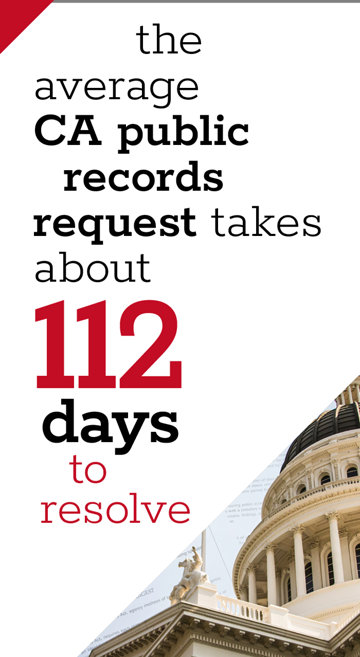
“Already California, by our studies, is 39th in the country for transparency. The average request takes about 112 days to be resolved in California, which is really bad, but this bill would have made it a lot worse.”
Cuillier said the bill’s submission rules could have allowed uncooperative agencies to erect deliberately unreasonable barriers.
“Agencies would be able to set the times and manners for accepting requests,” he said. “Some of them that don’t have good intentions could say you can only submit a request in person, by certified mail or hand-delivered with ID from 10 to 11 a.m.”
“The people’s business is the property of the people. You can’t keep it from us.”
Transparency advocates also objected to the way the most consequential provisions were added.
Rosenberg said the bill’s evolution sharply reduced the time available for public scrutiny and debate.
“The way the bill was proposed reduced the amount of public conversation about it, the amount of policy debate and the amount of time allowing groups and the public to weigh in,” she said.
“It stifled debate.
“We don’t think that was accidental—that was a choice. Pacheco is being motivated by city and county staff who get sick and tired of responding to public records requests and don’t want to do it anymore, regardless of what the law demands.”
David Snyder, executive director of the First Amendment Coalition, was equally direct.
“The only way that there’s any government accountability is that people know what the government is doing,” he said.
“This looked a lot like an effort to evade accountability.”
The California Public Records Act was enacted in 1968 and signed into law by Gov. Ronald Reagan. Its purpose rests on a principle fundamental to any functioning democracy: Government records belong to the public.
As the California Supreme Court has stated: “Implicit in the democratic process is the notion that government should be accountable for its actions. In order to verify accountability, individuals must have access to government files. Such access permits checks against the arbitrary exercise of official power and secrecy in the political process.”
That principle could hardly be clearer.
“The law was passed for a reason,” Rosenberg told Freedom. “If people don’t watch the government, the government does terrible things.”
Yet government agencies routinely resist the laws designed to make them answerable to the public.
Freedom Magazine has documented many of the tactics used to frustrate lawful records requests: unjustified secrecy classifications, claimed investigatory file exemptions, excessive search and review fees, yearslong delays, the destruction of emails and documents, and “Glomar” responses in which an agency refuses to even confirm or deny that requested records exist.
Some agencies spend fortunes in taxpayer money defending lawsuits brought by the very taxpayers from whom they are withholding records.
The tactics vary, but the objective is often the same: Make the process so slow, expensive or exhausting that the requester gives up.
AB 1821 threatened to turn several of those obstruction tactics into law.
That is why the defeat of the bill’s restrictive provisions matters beyond California.
Cuillier said access to government information has been deteriorating nationwide for years.
“That’s the trend we have been documenting for decades,” he told Freedom. “It is getting more and more difficult to get public records on the federal level too. Fifteen years ago, you could get records 38 percent of the time. Now it’s 10 percent of the time.
“What happens when it gets to zero? We have seen in history around the world what happens when you have secret police and secret government. Bad things happen, like corruption and targeting political foes. It is very, very dangerous.”
The danger is not abstract.
Government secrecy conceals misconduct. It shields waste. It enables officials to exercise public power without public scrutiny. And it deprives journalists, watchdogs and ordinary citizens of the evidence they need to expose abuse.
“The only way that there’s any government accountability is that people know what the government is doing,” Snyder said.
The answer, Cuillier said, is not simply to defend existing transparency laws but to strengthen them.
“We can demand from our legislatures to put some teeth into transparency laws with repercussions for violating the laws,” he said. “We can set up alternative enforcement mechanisms so we don’t have to rely on the courts all the time.
“People need to stand up and fight back.”
And in California, that is exactly what they did.
Newspapers sounded the alarm. First Amendment and transparency organizations mobilized. Citizens contacted lawmakers. The pressure reached the Senate Judiciary Committee, and the provisions that had generated the outrage were removed.
“The bill was a trial balloon to see if they could completely gut the California Public Records Act,” Rosenberg said. “The answer to that turned out to be ‘no.’
“It was good to see that there was so much support in fighting this. I think that was a good indicator for the future.
“It was the overwhelming public pressure that moved the needle.”
The victory does not mean the threat has disappeared. Government agencies will continue searching for ways to narrow transparency laws, raise the cost of obtaining records and make public scrutiny more difficult.
Citizens must therefore continue to insist on a simple principle.
“The people’s business is the property of the people,” Rosenberg said. “You can’t keep it from us. If we want to see it, you have to let us see it.”
The Church of Scientology has long championed freedom of information and the public’s right to know. That commitment reflects the recognition that democracy cannot function when citizens are denied the facts necessary to judge the conduct of those acting in their name.
As Scientology Founder L. Ron Hubbard wrote, “Democracy depends exclusively on the informedness of the individual citizen.”
AB 1821 would have made that informedness harder to achieve.
Instead, Californians became informed about the bill, raised their voices and gutted it.
The public watched the government.
And this time, the government backed down.