

Apparently, certain psychiatrists think you are.
Literally. They think you would be better off dead than depressed, schizophrenic or suffering from a host of other “mental conditions.”
The bottom line? They can’t “cure” you, so they want to kill you.
A shocking new trend in places where “physician-assisted suicide” is legally allowed for those suffering from a terminal or incurable illness is that form of suicide being marketed to patients who only suffer from mental health issues.
In other words, euthanasia—death—is being used as a solution to “mental illness,” even though psychiatry has no way of proving that the “mental illnesses” they diagnose you with even exist.
The euthanasia “cure” is infallible; it’s the one and only psychiatric “treatment” that actually works.
As former director of the National Institute of Mental Health Thomas Insel said, “The weakness is its lack of validity. Unlike our definitions of ischemic heart disease, lymphoma or AIDS, [psychiatric] diagnoses are based on a consensus … not any objective laboratory measure.”
In other words, it’s all malarkey—the kind that comes out of the backsides of bulls. Psychiatrists freely admit they have no proof of the conditions they label you with, but those same labels may now qualify you for physician-assisted suicide.
And once euthanasia enters the equation, the “cure” is permanent—there’s no going back.
The “treatment” is the very definition of the word “terminal.”
And the floodgates have already opened. In the Netherlands, for example, only two psychiatric patients were killed legally in 2010. By 2011, this had increased to 13 patients, and by 2012 to 14. By 2020, there were 88 euthanasia cases involving mental illness. That figure rose to 138 in 2023 and to 219 by 2024.
That’s an explosion of 10,850 percent in 14 years.
“The Dutch have discovered a cure for autism: murder,” read a National Review editorial. “Dutch law first was changed to accommodate ‘physician-assisted suicide’—i.e., medical euthanasia—for patients with severe conditions some years ago, and, as it turns out, some slopes are slippery: The Dutch soon decided that those suffering from psychiatric problems could be put down like unwanted pets, too, and now are eliminating those who have no diagnosed medical condition whatsoever save autism.”
In 2021, a total of 10,064 Canadians were euthanized. Only 2,100 shelter dogs in Canada were reported to have been put down that year.
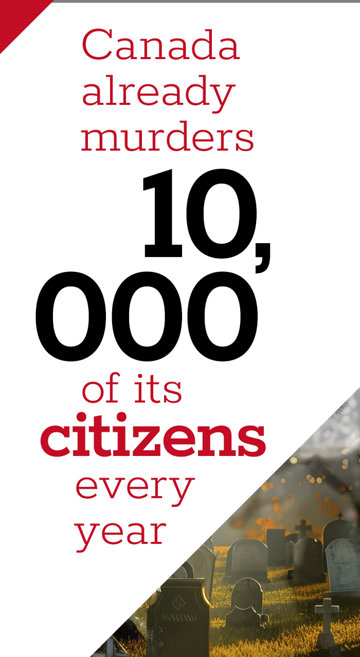
Needless to say, Canada is big on euthanasia. The country’s Medical Assistance in Dying (MAID) program is about to meet a “milestone” of 100,000 Canadians killed since the program began a decade ago.
That’s 10,000 murders per year.
Canada sure seems to have a very cavalier attitude about offing its own citizens.
And now, that same framework is expanding, moving from physical illness into mental health itself, with psychiatric patients now being killed just like those deemed “feebleminded” in the Nazi era.
Their “Final Solution” is passed off as “assisted suicide,” says the mental health watchdog Citizens Commission on Human Rights (CCHR) International.
“To shroud murder in the mantle of medical practice—‘assisted suicide’ for ‘mental illness’—is a crime in and of itself,” said CCHR International President Jan Eastgate.
And yet, Holland is doing it, Belgium is doing it and, very soon—likely by March 17, 2027—Canada will be doing it, too.
In 2024, the Canadian government postponed for three years the implementation of euthanasia for those with mental illness, stating that the country was simply not ready to expand the program.
Canada’s MAID law is “probably the biggest existential threat to disabled people since the Nazis’ program in Germany in the 1930s,” Tim Stainton, director of the Canadian Institute for Inclusion and Citizenship at the University of British Columbia, said.
History shows where that path can lead. In 1939, the Nazi government began a program to slaughter those it deemed unworthy of the right to live. That killing machine ultimately murdered 250,000 men, women and children suffering from physical or mental disabilities.
Doctors like Vancouver’s Will Johnston are opposing Canada’s MAID program. Originally, he explained, “Promises were made that no doctor would ever be coerced to participate in euthanasia, no doctor or nurse would ever lose their job because they wouldn’t cooperate with euthanasia. No hospital would have to do it. No nursing home, no palliative care unit would be forced to host doctors killing patients who wanted to die. All of that was a complete fiction.
“All of those things have now happened.”
The euthanasia “cure” is infallible; it’s the one and only psychiatric “treatment” that actually works. Whenever it’s used, all that’s left is a funeral… and a grave.
But there’s a Catch-22 in MAID’s application to mental illness—one that could ultimately cause Canadians to reject it altogether.
That Catch-22 is this: If you are hopelessly crazy enough to qualify for euthanasia, how can you simultaneously be considered sane enough to give informed consent?
The question isn’t hypothetical. The Canadian government explicitly states that to be considered for euthanasia, you must “give informed consent to receive medical assistance in dying.”
To be eligible to be a lamb led to the slaughter, you must “give informed consent to receive MAID, meaning that the person has consented to receiving MAID after they have received all information needed to make this decision.”
But if you’re supposedly nutty as a fruitcake, how could you possibly understand that the shot or the pill that “nice” psychiatrist is about to give you is a one-way trip to the cemetery?
Even Psychiatric Times admits, “Core criteria such as irremediability, decisional capacity and unbearable suffering were widely regarded as epistemologically unstable in mental illness, particularly in adolescents and young adults whose psychological development was still ongoing,” and cites a “growing uncertainty about whether psychiatry has crossed a boundary it cannot coherently justify.”
It all comes down to this: Psychiatrists can’t prove the existence of any of the mental illnesses they “diagnose” patients with. Even if they could, they can’t fix them—not with mind-numbing drugs, electroshock, lobotomies or counseling. The world is beginning to wise up about this.
So shrinks might as well declare that their patient (read victim) is “sane enough” to understand—and agree to—their own death.
And at that point, in walks the smiling ghost of Dr. Mengele, the Nazi “Angel of Death,” to determine who lives and who dies in the Auschwitz gas chambers.
We stopped that monstrosity in World War II.
Looks like it’s time to stop it again.