

But it’s true.
“I learned the tricks last year from an old friend, Marg Moore, who heads our FOIA office and also hates FOIAs,” he said.
How arrogant, corrupt and stupid do you have to be to break the law as a public official and openly brag about it—in writing, no less?
Morens did not merely try to avoid FOIA scrutiny. He bragged about it as though evading public records law were a professional accomplishment.
“I learned from our foia lady here how to make emails disappear after I am foia’d but before the search starts, so I think we are all safe. Plus, I deleted most of those earlier emails after sending them to gmail,” Morens wrote in a February 24, 2021, email to the president of an organization whose NIH funding was under scrutiny.
Two months later, he was still reassuring the same pen pal. “PS, I forgot to say there is no worry about FOIAs. I can either send stuff to Tony [Fauci] on his private gmail, or hand it to him at work or at his house. He is too smart to let colleagues send him stuff that could cause trouble.”
By June, Morens had reduced the practice to a rule. He advised a prominent COVID scientist that “the best way to avoid FOIA hassles is to delete all emails when you learn a subject is getting sensitive.”
How arrogant, corrupt and stupid do you have to be to break the law as a public official and openly brag about it—in writing, no less?
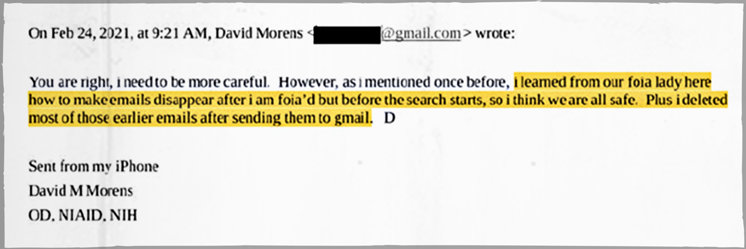
Morens may have thought he was making emails “disappear.” Instead, he was creating a permanent record of his own intent to evade the law.
That’s why the 78-year-old senior government official has now been formally indicted for “destruction, alteration or falsification of records in federal investigations; concealment, removal or mutilation of records; and aiding and abetting,” according to the Department of Justice (DOJ).
If convicted, Morens could receive a five-year sentence for conspiracy against the US, 20 years in prison for each count of destroying, altering or falsifying records in federal investigations and three years in prison for each count of concealment, removal or mutilation of records.
That means the former NIH official could spend the rest of his life in prison.
“We caught Dr. Morens red-handed,” said House Oversight Committee Chair James Comer, who applauded the DOJ “for taking action to hold this public official accountable for hiding information from the American people.”
Acting Attorney General Todd Blanche said, “These allegations represent a profound abuse of trust at a time when the American people needed it most—during the height of a global pandemic.
“As alleged in the indictment, Dr. Morens and his co-conspirators deliberately concealed information and falsified records in an effort to suppress alternative theories regarding the origins of COVID-19. Government officials have a solemn duty to provide honest, well-grounded facts and advice in service of the public interest—not to advance their own personal or ideological agendas.”
The indictment also states that Morens was informed during training that NIH business was not to be conducted on a personal email account.
But for Morens, following the law was apparently too much trouble. “We all dread these FOIAs,” he wrote in April 2020. “They take up so much time.”
“Public officials who disregard their legal obligations undermine the transparency that keeps our federal programs strong,” Marcus L. Sykes, special agent in charge of the US Department of Health and Human Services Office of the Inspector General, said. “The deliberate mishandling and concealment of records in a federal investigation is not just a breach of duty; it is a betrayal of public trust.”
The Church of Scientology couldn’t agree more. For decades, the Church has fiercely advocated for freedom of information, inspired by Scientology Founder L. Ron Hubbard’s principle: “Democracy depends exclusively on the informedness of the individual citizen.”
Perhaps Dr. Morens will learn that lesson now.