

The National Human Rights Commission of Korea announced on February 19 that the hospital’s actions constituted a serious infringement of patients’ constitutional right to bodily freedom, recommending that the mayor of Bucheon impose administrative sanctions on the psychiatric facility.
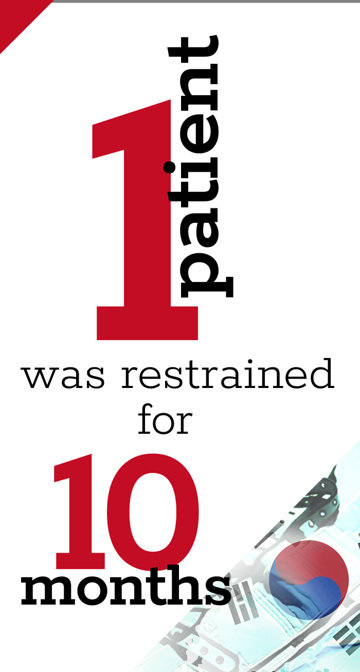
Among the cases documented was one patient whose arms were restrained immediately upon admission—and remained tied for 10 months.
Two hours later, she was found with a swollen abdomen and nosebleed and later pronounced dead.
Further, 53 patients who were unable to communicate and lacked the capacity to complete their own admission consent forms were falsely classified by the hospital as “voluntary” admissions, blocking their right to seek release. The hospital also installed illegal locking devices in wards designated as “open,” operating them as de facto closed units and controlling patient movement.
Investigators confirmed that nurses and caregivers restrained 52 patients without directly examining them first, and without receiving specific instructions from a specialist to do so. Others were kept in four-limb restraints, with each arm and leg secured separately to the bed at all times except during meals. “Caregivers” were found storing physical restraint devices in personal lockers—rather than under formal hospital control—and routinely used them to tie patients down overnight.
The inquiry also uncovered coordinated efforts to alter documentation. A head nurse instructed staff via group chat to leave false records stating that “restraints were applied under the specialist’s instructions” or to delete entries that could cause problems.
The commission recommended that the Bucheon mayor issue corrective orders and impose fines, that the hospital director reclassify patients who lacked the capacity to communicate and halt unlawful restraint practices, and that the Ministry of Health and Welfare establish specific and strict national standards governing the use of physical restraints in psychiatric facilities.
The commission’s report lands amid mounting scrutiny of psychiatric confinement practices in South Korea, where recent high-profile abuse cases in Bucheon have already drawn police investigations, criminal indictments and public outrage.
In August 2024, the commission undertook an investigation into the death of a patient at a mental hospital run by celebrity psychiatrist Yang Jae-woong, a frequent television personality. “We have received complaints of human rights violations at the hospital and will conduct an on-site investigation according to the procedure,” an official told the Korean daily Hankyoreh, adding that medical records and closed-circuit television (CCTV) footage had been secured.
The case centered on a woman in her 30s who was admitted for treatment to handle her addiction to diet pills, and who died 17 days later. Surveillance footage obtained by police showed staff restraining her hands, legs and upper torso after she was forced to consume a tranquilizer.
Two hours later, she was found with a swollen abdomen and nosebleed and later pronounced dead. The National Forensic Service assessed the likely cause of death as acute intestinal pseudo-obstruction.
Prosecutors later detained a doctor and indicted four nurses on suspicion of professional negligence resulting in death. Investigators alleged failure to properly monitor the patient, improper administration of psychotropic drugs and falsification of medical charts.
In March, the Human Rights Commission referred the case to the Supreme Prosecutors’ Office, calling for an investigation into falsified records and negligence.
Established in 2001, the National Human Rights Commission of Korea serves as an advocacy institution for the protection of human rights, committed to upholding “dignity, value and freedom of every human being” as reflected in international treaties to which South Korea is a signatory.
The commission’s February 19 findings extend that mandate squarely into psychiatric wards, where the tension between clinical authority and personal liberty is acute. By formally deeming prolonged restraints and falsified admissions constitutional violations, the commission elevated the issue from regulatory compliance to one of fundamental rights.
Whether Bucheon’s mayor imposes meaningful penalties, and whether the Health Ministry codifies binding standards on the use of restraints, will determine the practical reach of the commission’s recommendations.
For families who have entrusted loved ones to psychiatric institutions, the focus now shifts from investigation to reform.
No one should be tied to a bed, confined without lawful consent or erased from the record under the guise of “care.”