

On a New York bus, that same hostility took physical form. A man shouted, “We don’t wear that in this country!” as he tried to rip a Sikh teenager’s turban from his head, then beat the boy.
In Alabama, the violence proved fatal. Sikh musician Raj Singh was shot and killed while standing outside a gurdwara. He was 29 and the sole provider for his mother, two sisters and younger brother in the wake of his father’s death.
“Sikhs clearly remain disproportionately at risk of targeted violence and discrimination.”
This is not a series of one-offs. Preliminary FBI data released in April 2026 reveals a stark pattern: Attacks targeting Sikh communities surged to their highest levels on record. Over the past decade, anti-Sikh hate crimes in California alone have exploded by 3,700 percent, according to an analysis of data from the California Association of Human Relations Organizations.
There are up to 30 million Sikhs worldwide, but fewer than 1 million live in America, or less than one-fifth of 1 percent of our nation’s population. As such, they stand out—the turban and beard often causing bigots to mistake them for Muslims. Sikh illustrator and performance artist Vishavjit Singh, for example, escaped the 1984 anti-Sikh massacre in India only to face exclusion and suspicion in America. Since 9/11, the taunts have become even uglier. Strangers used to call him “genie” and “raghead”—now they call him “terrorist” or “Osama bin Laden.”
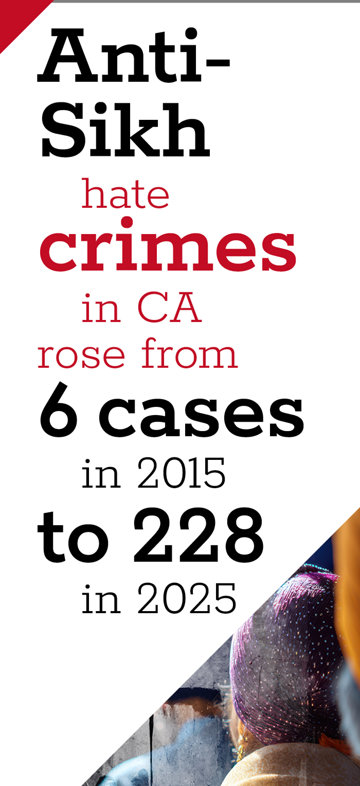
Overall hate crime incidents in the United States dropped by 11 percent in 2025, yet attacks targeting Sikh communities surged to their highest levels during the same period.
The important factor, according to Sikh Coalition Executive Director Harman Singh, is that “Sikhs clearly remain disproportionately at risk of targeted violence and discrimination.”
“We are alarmed by reports of a significant increase in anti-Sikh hate, and it is critical to better understand where these increases are being reported and how widespread the surge might be,” Singh told Freedom. “All told, wherever this rise in hate crimes and bias incidents is manifesting, it is almost certainly being driven by multiple factors,” he said. Singh cited inflammatory online rhetoric stoked by foreign governments and their proxies, xenophobia and repressive policies as examples of forces that fuel anti-Sikh hate.
Lawmakers are beginning to respond. In January, Reps. Josh Gottheimer and David Valadao introduced the Sikh American Anti-Discrimination Act—an effort to force federal attention onto a problem long ignored. At its core is a proposed Department of Justice task force dedicated to tracking, investigating, and preventing bias and violence against Sikh Americans.
For many Sikhs, the bill is a long-overdue recognition. In the decades since 9/11, the community has faced a persistent and often misunderstood form of targeting, where religious identity, racial profiling and geopolitical tensions collide. Community leaders say the legislation could finally bring a measure of accountability, while helping prevent the kind of violence that has left families and communities shaken and on edge.
Among them is Bhupindar Singh, Outreach Lead for the New Jersey Sikh Youth Alliance Inc. The Sikh community, he said, has lived in the “shadow of prejudice and systemic exclusion” because the law lacked a clear framework to define the specific hate they face. Dr. Pritpal Singh of the American Sikh Caucus Committee echoed the sentiment and welcomed the new legislation, saying that Sikhs have “endured hate, violence and credible threats to their lives” for “far too long.”
Sikhs are attacked for the same reason any minority is attacked: They are regarded as dangerous and evil because they look different. The irony is that the very markers that make them targets—the beard and turban—were intended as visible commitments to responsibility and trust.
A survivor of the post-9/11 massacre at Wisconsin’s Oak Creek temple put it succinctly: The turban is a symbol, “a way we can’t hide, a way we’re accountable for our actions. We have to live our lives based on the principles of our faith because we have the look now, we represent the faith.… The hatred that led to the deaths of those six martyrs in our temple that day and led to many deaths across the world can be overcome by the love [that comes from] understanding each other as human beings and seeing God in each other.”