

In Nigeria, 14-year-old Leah Sharibu was kidnapped and told she must renounce her Christian faith. She refused. That was in 2018. For this, she remains captive to this day, facing the constant threat of death or the fate of a “slave for life.”
In Yemen, Libi Marhabi, a Jew arrested in 2016 for allegedly smuggling a Torah out of the country—a text the government treated as state property rather than scripture—remains in prison. Authorities blocked communication with his family members, subjected him to hourslong interrogations, beat him, starved him and tortured him with electric shocks. The abuse caused all his teeth to fall out and worsened his kidney and lung conditions.
“Far too many people in key nations are denied religious freedom through unjust laws, discrimination, harassment, violence and even crimes against humanity.”
The United States Commission on International Religious Freedom (USCIRF) exposes these and countless other abuses, shining a spotlight on violations that strip individuals of the basic right to practice their faith.
On March 4, USCIRF released its annual report on global religious liberty, detailing conditions worldwide and offering policy recommendations to the president, secretary of state and Congress. Commissioners of the independent, bipartisan government entity spoke before an audience of dignitaries, journalists, activists and religious leaders in the Longworth House Office Building on Capitol Hill.
“China arrests underground church members, mob violence is on the rise in India and Pakistan, leading to attacks on religious minorities and the destruction of their homes, Burma’s military bombs houses of worship and Tajikistan denies parents the right to teach their children about faith,” said USCIRF Chair Vicky Hartzler. “As USCIRF’s annual report shows, far too many people in key nations are denied religious freedom through unjust laws, discrimination, harassment, violence and even crimes against humanity. The US government must continue to advance religious freedom abroad to make a difference for those facing religious persecution.”
And so the presentation proceeded, with commissioners condensing a 100-page report into a single hour. Within those pages are stark examples of how far governments and societies can descend when driven by hatred or fear of the beliefs of others:
- The government of Hungary has targeted the Church of Scientology through raids, denial of occupancy certificates and seizures of confidential confessional parishioner files.
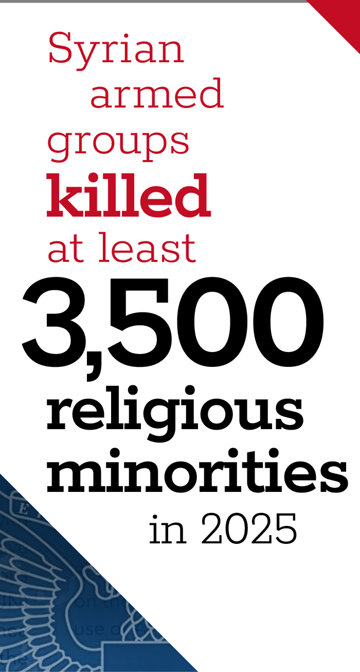
- The new Syrian government, despite proclaiming support for the rights and protection of religious minorities, allowed pro-government armed groups to slaughter an estimated 1,500 Alawis, a Shiite Muslim community, and at least 2,000 Druze, members of an Abrahamic, monotheistic faith.
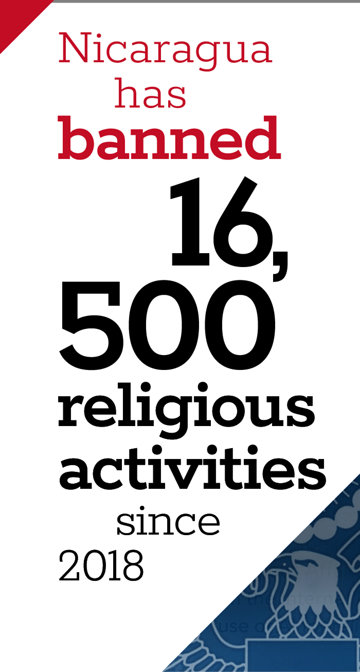
- Nicaragua’s authoritarian government has targeted Christianity in an effort to eliminate independent and influential institutions it views as rivals. It has banned more than 16,500 religious processions and activities and carried out over 1,000 acts of repression against the Catholic Church alone since 2018, including property confiscations, arbitrary closures and public threats. In January 2025, the regime dissolved 15 nonprofit organizations, including the Ebenezer Christian Missionary Foundation, the Pentecostal Ministry Foundation Christ Is Coming and the Dominican Nuns Foundation of Nicaragua. And, for the third consecutive year, the government dramatically restricted Holy Week celebrations.
- The Eritrean government currently confines some 10,000 prisoners of conscience and detainees of all types in over 300 facilities around the country. The “facilities” range from dilapidated concrete structures and metal cargo shipping containers to simply holes in the ground. Detainees are coerced to renounce their faith, forbidden to pray aloud and are subjected to brutal treatment including prolonged exposure, waterboarding, hanging, sexual violence and electrocution.
Each year, USCIRF recommends that the US government designate the world’s most egregious, systematic and ongoing violators of religious freedom as Countries of Particular Concern (CPCs). Created under the 1998 International Religious Freedom Act, the CPC label can trigger heightened diplomatic pressure and potential economic sanctions. In this year’s report, USCIRF identified 18 countries that meet the CPC threshold: Afghanistan, Burma, China, Cuba, Eritrea, India, Iran, Libya, Nicaragua, Nigeria, North Korea, Pakistan, Russia, Saudi Arabia, Syria, Tajikistan, Turkmenistan and Vietnam.
USCIRF’s Special Watch List, also released in the report, identifies countries that engage in or tolerate severe violations of religious freedom but do not meet the strict threshold—“systematic, ongoing and egregious”—required for CPC designation. This year, 11 countries were placed on that list: Algeria, Azerbaijan, Egypt, Indonesia, Iraq, Kazakhstan, Kyrgyzstan, Malaysia, Qatar, Turkey and Uzbekistan.
In addition to documenting violations by country, the commission also identifies emerging trends in religious persecution. One disturbing development is the growing use of cross-border tactics—including murder—by governments to silence critics, attack perceived enemies or target their own citizens in exile, a practice known as cross-border religious violence or transnational repression.
“USCIRF is a highly respected independent commission with exceptional depth of expertise. They never compromise.”
USCIRF cited the Iranian government’s 2025 global campaign targeting Jews. In January, Azerbaijan’s State Security Service arrested two men recruited by Iran in a failed plot to assassinate a prominent and outspoken rabbi. A separate plot in the United Kingdom—also linked to Iran—involved third-party agents and cyberattacks aimed at murdering or kidnapping “prominent Jewish individuals.” In Germany, authorities arrested three suspects accused of procuring firearms and ammunition for an attack on a Jewish target on behalf of Hamas.
In 2025, Congress introduced more than 50 bills and resolutions aimed at advancing religious liberty. Across the report’s 100 pages cataloging abuses worldwide, some countries are also making measurable progress: Italy, Canada, Switzerland, Sweden and Denmark have launched strategies to combat antisemitism, while the United Kingdom and Australia are developing national initiatives to address Islamophobia.
Building on this positive momentum, the European Parliament took a stand last year by adopting multiple resolutions condemning religious freedom abuses across the globe. Members explicitly denounced restrictions on Christians and Baha’is in Iran, violations against Christians, Druze, Muslims and Yazidis in Syria, and the ongoing repression of Uyghur Muslims in China’s Xinjiang region—sending a clear signal of concern from one of the world’s largest democratic legislatures.
USCIRF’s annual report carries significant weight both domestically and internationally. Anna Sineva, Director of Government Relations and Public Policy for the Church of Scientology National Affairs Office in Washington, DC, observes that the commission’s findings are widely respected by policymakers and foreign officials alike. “USCIRF is a highly respected independent commission with exceptional depth of expertise. They never compromise. When USCIRF highlights religious freedom violations in a country, their precise and accurate reports open doors for advocacy. As an independent government commission, they provide a credible foundation that enables constructive dialogue and facilitates communication that might never otherwise happen—empowering religious freedom advocates to push for meaningful change.”
USCIRF’s credibility gives the commission influence far beyond the pages of its annual report. Documenting abuses is not an end in itself—it is a catalyst for safeguarding the most fundamental human right: religious freedom, a principle woven into the very fabric of America.
USCIRF Chair Vicky Hartzler closed the presentation by reaffirming the commission’s guiding purpose: “Why we do what we do is for the people around the world. We want every individual to be able to have that freedom to live out their faith according to their deeply held beliefs. That’s what fuels all of our work.”