


The gap lies in a little-known exemption: While most public employees must preserve records, state lawmakers aren’t required to retain their correspondence. As a result, they can legally erase emails, calendars and other documents, so that nothing remains to disclose when a records request arrives.
That flaw moved back into the spotlight on March 15, when State Representative Clinton Anderson introduced a bill aimed at closing the loophole during Sunshine Week, the annual national observance promoting open government. The proposal seeks to require legislators to follow the same retention rules as other public officials, ensuring that records subject to disclosure still exist by the time they’re requested.
If documents have already been deleted, offices can respond to requests with… nothing at all.
Much more than a procedural fix is at stake here: Public records form the evidentiary backbone of accountability journalism and civic scrutiny, shaping what citizens know about how decisions are made, whose voices are heard and how public resources are used. Without reliable retention, that record becomes fragmented, limiting the ability to reconstruct decisions that impact communities across the state.
Under current law—specifically Wisconsin Statute § 16.61(2)(b)1—legislators are exempt from records retention requirements, even though they remain subject to records requests. The distinction creates a peculiar legal structure wherein compliance is mandatory but preservation is optional. If documents have already been deleted, offices can respond to requests with… nothing at all.
Transparency advocates argue this framework has consequences. Bill Lueders, president of the Wisconsin Freedom of Information Council, warned that the exemption “allows legislators to make things go away that they would rather not see the light of day.”
Examples suggest the scenario is hardly hypothetical. One lawmaker acknowledged that his office “frequently deletes emails during the normal course of business each day.”
For lawmakers seeking reform, the issue is also grounded in personal experience. State Senator Chris Larson has described arriving in the legislature after serving as a county official—where record retention was required—only to be advised by IT staff to delete emails as storage filled up.
Larson’s office has framed the consequences in broader terms. Spokesman Justin Bielinski argued that the exemption “creates a perverse incentive to do the people’s business in secret.”
The debate over whether lawmakers should be required to retain records subject to public disclosure has played out repeatedly in the legislature, where similar proposals have, to date, struggled to advance. Versions of this same reform have been introduced in prior sessions, only to stall without hearings or votes. The latest bill, introduced after the Assembly had already adjourned for the year, faces similarly long odds.
Efforts to address the issue have also surfaced in the executive branch. Governor Tony Evers included a provision in his 2025 budget proposal that would have removed the legislature’s exemption and provided funding to implement the change—$72,300 in the first fiscal year and $96,400 in the next, along with a full-time position to manage compliance. The legislature’s Joint Finance Committee ultimately stripped the measure from the final budget, leaving the status quo intact.
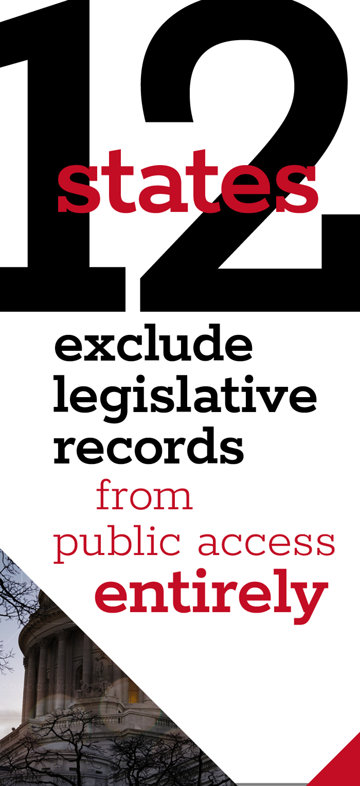
Beyond Wisconsin, the question of legislative transparency reveals a patchwork national landscape. Research cited by The Journal of Civic Information indicates that 12 states exclude legislative records from public access altogether. Others provide partial visibility. Congress, for its part, exempts itself from the federal Freedom of Information Act.
Even where access exists, retention practices determine whether meaningful oversight is possible. In Michigan, for example, automatic deletion policies for certain digital communications limit what can be retrieved through public records requests. In Los Angeles, a 24-hour auto-delete messaging system drew scrutiny for undermining compliance with state law. And in Scotland, revelations that officials erased pandemic-era messages prompted introduction of legislation to criminalize the destruction of government communications. Each case illustrates how the mechanics of recordkeeping—what is saved, for how long and in what format—shape the boundaries of transparency.
Within Wisconsin, the practical impact of open records laws can be seen in the reporting they enable. Journalists have used retained documents to uncover how private equity ownership affects residents in manufactured housing communities, examine gaps in prison work release programs, and analyze environmental policies such as beaver dam removal across multiple states. Without these stories, the realities of such systems would remain obscured.
Any proposed reform, then, centers on a structural issue: whether lawmakers should be governed by the same recordkeeping standards as the officials whose actions they oversee. Advocates argue that aligning those standards would strengthen confidence in legislative decision-making and ensure that all public business leaves a paper trail.
For now, Wisconsin’s “delete button” remains intact—a quiet feature of the law that has outsized implications. Whether it persists or is eventually removed will determine not only how much the public can learn about its lawmakers, but whether the state’s transparency framework fulfills its promise at all.